blog

Chewing-gum Street Art

I know its not normally something people might associate me with, but when local artist and all-round legend Ian Rolls called for local artists to assist with his latest street art project, I was in! The last year has been so devoid of opportunities, how could I possibly resist an invitation to scrape around on the cold, dirty floor, getting bemused looks from passers by? “It’ll be just like the archaeology days!” I said.

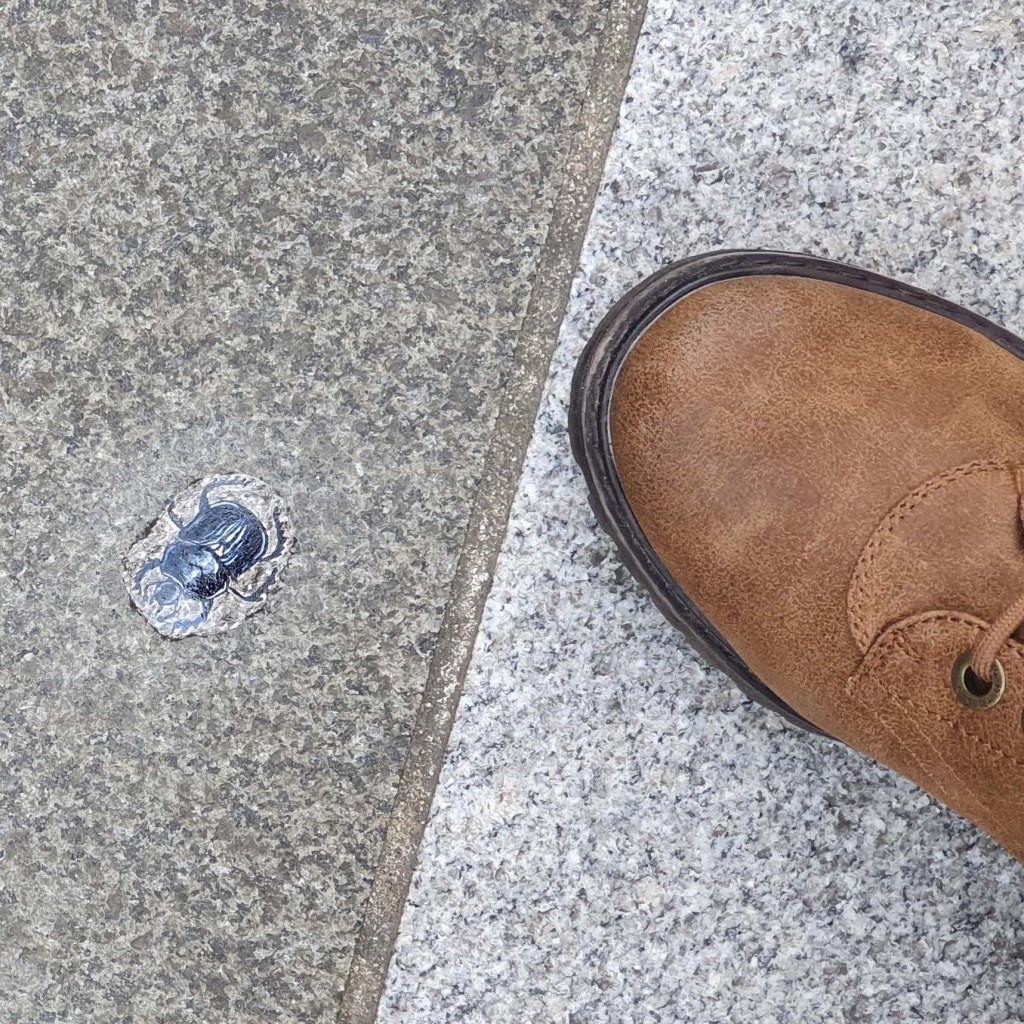
As implied, each artwork was to be created on a single piece of discarded gum, firmly trodden into the granite surface of Pitt Street, and now to be our canvas. Although I was slightly concerned the knees might not withstand that kind of thing, but there was only one way to find out. Well equipped with a many roll mats and kneeling pads as I could possibly obtain, I made my way down to Pitt Street, central St Helier.

On arrival I found that Ian had meticulously prepared each piece of chewing gum with a light sandpaper and some acrylic primer. Immediately, my fears regarding painting a substance that had recently been in someone’s mouth during a pandemic subsided. It was a dry but cold morning when myself, Ian and a few other local artists, including Theo Jenner (better known as Jerzilla) set about our miniature masterpieces. A large amount of chewing-gum has been dropped in Pitt Street, so what better way to highlight this while adding a little colour and interest at the same time. For my paintings I chose to bring nature into town with me, including a Dor Beetle. Dor Beetles are large shiny black beetles found in the UK and are related to the Scarab, and like the scarab are a type of dung beetle. You could say they are nature’s recyclers….the unsubtle hint being that humans should put their chewing gum in the bin (as I’m afraid no beetle will do that for you). As you can imagine, some very small brushes were required and I thoroughly enjoyed using acrylic paint again after a long break from it.

Once completed, each miniscule canvas was carefully masked and sprayed with a varnish to protect them from clumsy passers-by who don’t look where they are going (the irony that I’ve been imploring people to look up for years) and the elements.

I won’t ruin the surprise by describing all the tiny wonders that are to be discovered on Pitt Street, but I recommend next time you are there, remember to look down to your feet for something you won’t see every day, and may never again! After all, as with all street art, the nature of the work is transient and who knows when the next enthusiastic Government of Jersey worker will come along with a power-washer. Still, as a friend said “This is one of the more unusual things you have done….one of”.

Stones and Stars Series I

Devil’s Den

A rather overdue post, but nonetheless I wanted to share a bit more background to this series and how it came into being. 

In early 2020 I was inspired to create a new series by the beautiful night sky photography of Beckie Burr. Beckie’s photos captured the majesty of some of Britain’s best archaeological sites, among the eternal backdrop of the night sky. As I had already explored these themes (separately) within my artwork, Beckie’s photos really resonated with me and I was excited to produce my own impression of these scenes. As usual a mix of the mystical and the scientific proved tantalising!

A few months later, a triptych of night sky paintings were complete, utilising my archaeological illustration experience and my newly refreshed watercolour painting skills. The stones were illustrated using my favourite Rotring Isograph pens to render the stones with detailed dotwork. For the night skies, I used Kuretake Gansai Tambi watercolours, which have vivid colour and a rich velvety finish, which was perfect for the depths of night.

These are the three sites which feature in my final tryptic.

Brane Barrow, Cornwall, UK

One of the many things that attracted me to the photo Beckie took of this site was that the barrow entrance was like a doorway into a magical universe. Not surprising then that this type of Neolithic burial monument is known as an Entrance Grave. I was subsequently amused to read (thanks Wikipedia) that one of the reasons the barrow remains standing in such great condition is that the 19th century farmer considered it “good shelter for sheep and pigs”. So much for my romantic notion of escaping to Narnia then.

Avebury, Wiltshire, England

Undoubtedly the most well-known of the three sites, Avebury encompasses Europe’s largest stone circle, and is one of Britain’s’ most iconic ancient monuments. Avebury’s stones may be more thinly distributed than those at nearby Stonehenge, but they are surrounded by a huge henge (so huge there is a village within it’s bounds). Built in the Neolithic, it’s currently estimated the oldest phase of construction is around 3,000BCE, but with archaeological investigations ongoing, watch this space. It’s a great site to stroll around as you can really get “in among the stones”. Teenage me highly recommends a visit!

Devil’s Den, Wiltshire, England

Another monument within the ancient Stonehenge / Avebury landscape, one of the things everyone seems to agree on is that the giant sarsen stones were re-erected during the 1920’s. Less clear are it’s age and purpose, with some describing it as a Chromlech / dolmen and others believing that the stones would have formed part of a (since ploughed away) long chamber. Many folklore tales surround the stones, including that a demon could be summoned by pouring water on the stones. Whatever it’s true origin, the site has a mystical energy which has captured the imagination of generations.

Lots of info to be found on this great website: Devil’s Den, Clatford, Wiltshire | The Northern Antiquarian (wordpress.com)

Thanks for reading! Please don’t forget to follow Beckie’s stunning page on Instagram: Beckie Burr (@beckieburr) • Instagram photos and videos

All of the Stones and Stars Series are now available as prints in my Esty shop:

Art & Illustration by AliArtology on Etsy

coastal fortifications – Illustrative Series I

Although only 45 square miles of island, Jersey has been extensively fortified over history.  

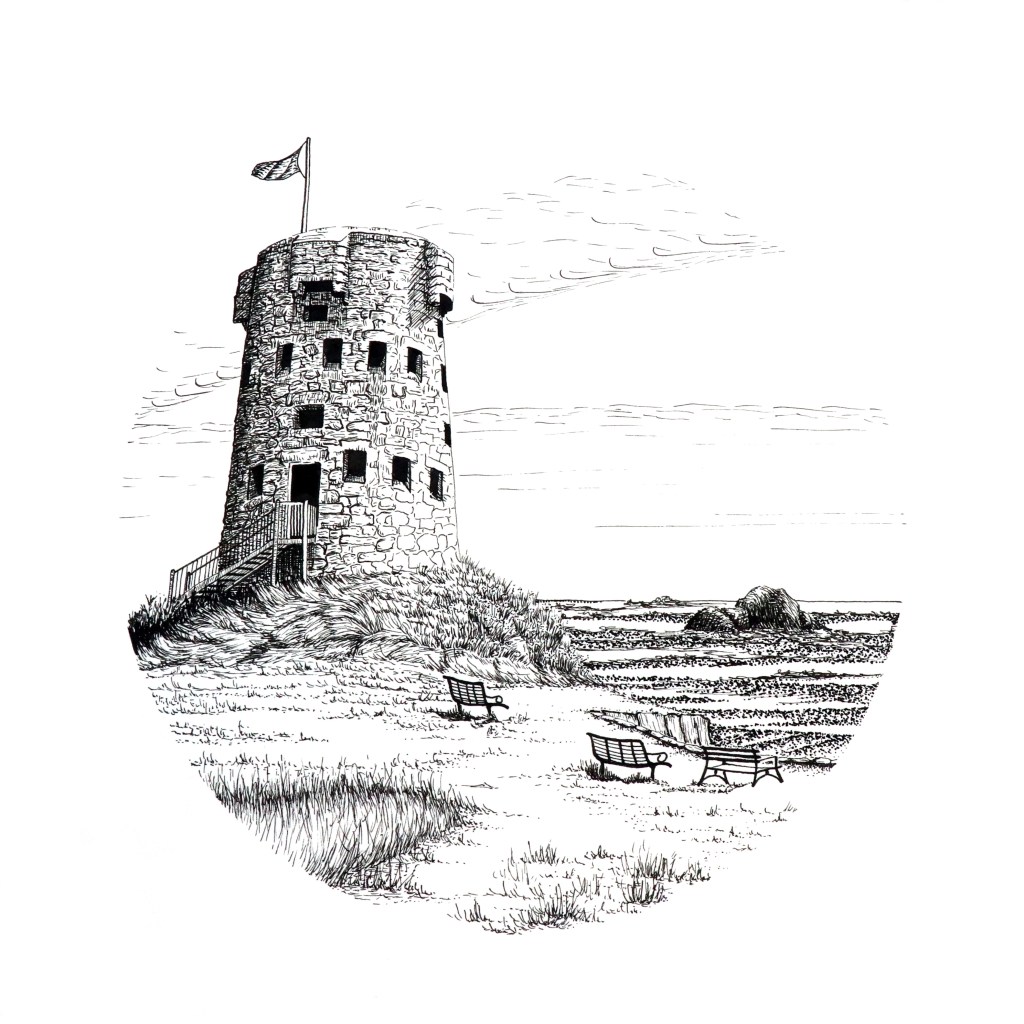
Le Hocq Tower

For my illustrations, I have initially focused on the towers built in the late 18th Century by Jersey Governor Henry Seymour Conway. Motivated by the American War of Independence which begun in 1775, the French declared war with Great Britain three years later. Jersey, as the closest British Isle to France (just 14 miles) became an obvious target for invasion. Conway requested the construction of new fortifications to defend the island, in total 23 ‘Conway’ towers were built. As anticipated, there were numerous skirmishes with the French in the years that followed, including the Battle of Jersey, and ultimately, the outcome of the wars were not in Britain’s favour. However, Jersey was successfully defended and retained as British, as it had been since 1204.

Constructed of the warm orange and pink coloured local granite, today the Conway towers form a picturesque part of Jersey’s coastline. Many retain a practical value, painted white and red as navigation markers for shipping. Then as now, they all have one thing in common: a key strategic and defensive and position on our coastline. ff

heads & tales

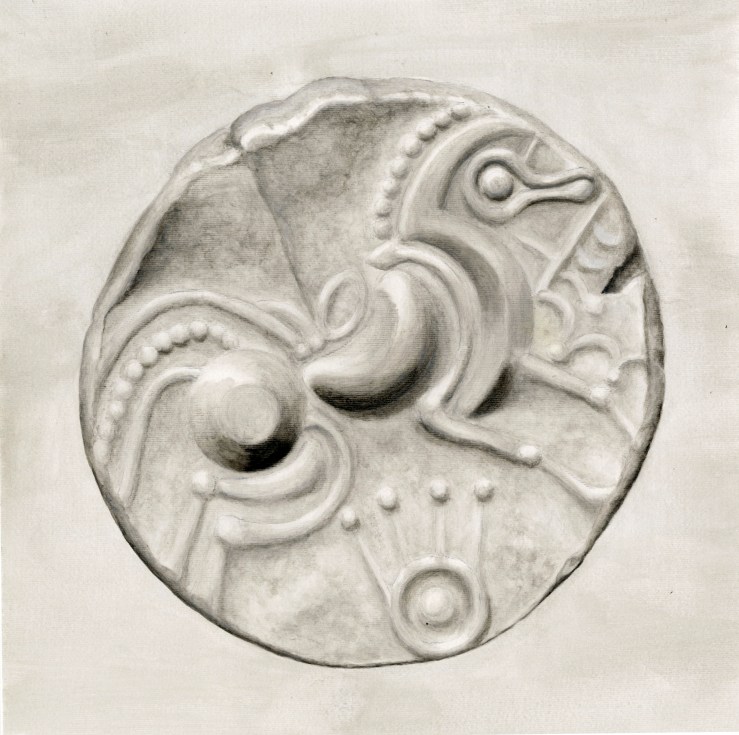
original artwork for the Being Human exhibition

Heads & Tales

2,000 years ago, nearly 70,000 coins and other precious items were buried in a field in Jersey. Their discovery has led to further reflection on their story, and the culture that hid them.

The Coriosoliate tribe coins which have inspired my work are highly stylised, displaying a strong Celtic, Iron Age cultural identity. In a world without media, the human desire to share the tribe’s image and appearance was prevalent, and the opportunity to express the tribe’s identity in a portable item was accepted. The coins show a remarkable level of precise detail which is extraordinary given the basic technology available. Then, as now, it was both a security feature of the coins that they were produced using the most sophisticated techniques, and a point of tribal pride that the coins were of such quality.

And what of the people who owned these coins? Contemporary Roman literature paints them as a savage and uncivilised race to be conquered, even using the relative equality experienced by Celtic women as evidence of their barbarism. We are aware from contemporary writings that Celtic women were able to bear arms and take part in warfare, they could hold senior positions such as judges and negotiators, and there are examples of Celtic women leading tribes (such as Boudica), they had rights over property even within marriage.

We know from the timing of the coins’ burial that the Celtic tribes of Gaul were being invaded by the Romans, and it was likely this event that motivated the Celtic tribes to hide their wealth from the advancing Roman forces. Sadly, no one ever returned for their hidden treasure.

Thank you to Jersey Heritage and the Le Catillon II hoard coins for inspiration

https://www.jerseyheritage.org/celtic-coin-hoard

hello

Hello & welcome to all. I’m so excited to announce the launch of my website and I hope you will join me on my artistic adventure.

I’ll be sharing my original works of art, together with some blogs on local sites and history, which are often my source of inspiration.

Thank you & best wishes, Ali